Anti-Static Canvas Fabric Wholesale: The Industrial ESD Sourcing Guide
---
Primary Keyword: anti static canvas fabric wholesale Secondary Keywords: ESD conductive fabric supplier, anti-static industrial textile manufacturer, static dissipative canvas bulk Target Audience: B2B procurement managers, electronics manufacturing buyers, cleanroom facility directors, industrial safety equipment importers Word Count: ~1,450 words (body only) Published: July 2026
Executive Metadata
- Market Context: The global anti-static fabrics market was valued at USD 1.2 billion in 2025 and is projected to reach USD 2.5 billion by 2034, growing at a CAGR of 9.2%. Semiconductor expansion, EV battery manufacturing, and tightening IEC 61340-5-1 compliance requirements are the primary demand drivers. - Technical Scope: Carbon-grid conductive yarn integration, surface resistivity classification (10^5–10^11 Ω/sq), EN 1149 / IEC 61340 / ANSI ESD S20.20 compliance, mechanical durability of ESD properties through laundering cycles. - Differentiation from previous articles: Unlike Week 3 (fire retardant — chemical safety) and Week 4 (water repellent — outdoor protection), this article addresses electrostatic control — the invisible hazard that destroys semiconductor yields, triggers dust explosions in chemical plants, and violates cleanroom protocols.
Static Discharge: The Billion-Dollar Problem Your Fabrics Should Solve
Every year, electronics manufacturers lose an estimated 4–8% of revenue to electrostatic discharge (ESD) damage — fried PCBs, degraded ICs, and latent component failures that surface only after shipment. In chemical processing facilities and grain silos, a single static spark can trigger a catastrophic dust explosion. In cleanrooms, static-attracted particulates compromise ISO Class certification.
Yet many sourcing managers still procure industrial canvas fabric based on tensile strength and coating alone — never asking the question that matters most in sensitive environments: What is the surface resistivity of this material?
For buyers sourcing anti static canvas fabric wholesale for ESD-sensitive applications, understanding the distinction between a spray-on antistat that washes out in six cycles and a permanently conductive textile is the difference between a compliant facility and a liability.
The global anti-static fabrics market — valued at USD 1.2 billion in 2025 and accelerating at 9.2% CAGR toward USD 2.5 billion by 2034 — confirms this is not a niche concern. It is the new baseline for industrial textile procurement in electronics, automotive, aerospace, and pharmaceutical supply chains.
Technical Deep Dive: How Anti-Static Canvas Fabric Works
The Physics of Static on Textiles
Standard polyester and cotton-blend canvas fabrics are natural insulators — surface resistivity above 10^12 Ω/sq. When these fabrics move across machinery, rub against packaging, or are handled by operators wearing synthetic clothing, triboelectric charging accumulates. The charge has nowhere to go, so it builds until discharge occurs — either as a spark (catastrophic in flammable atmospheres) or as an invisible current that destroys sensitive microelectronics.
Anti-static canvas addresses this through one of three engineering strategies:
1. Integrated Conductive Yarns (Permanent ESD)
The gold standard for industrial anti-static canvas. Conductive fibers — typically carbon filament (20D/3F to 70D/24F), stainless steel staple fiber, or conductive polymer yarns — are woven into the base fabric at regular intervals, forming a grid or stripe pattern.
- Carbon Grid: Black carbon yarns woven in a 5mm–10mm grid pattern. Surface resistivity: 10^5–10^8 Ω/sq (static dissipative to conductive range). Remains effective through 50+ industrial laundering cycles. - Conductive Stripe: Parallel conductive yarns at 10mm–20mm spacing. Lower cost; effective when grounding is directional (e.g., curtain panels hung vertically). - Metallic Blend: Stainless steel fiber (6–12μm diameter) blended at 2–5% by weight into the yarn before weaving. Applications requiring both ESD and cut resistance.
The key differentiator: conductive yarns are structural, not topical. They do not wash out, wear off, or degrade under friction.
2. Durable Polymer Coating (Semi-Permanent)
Cross-linked hydrophilic polymer coatings — typically polyamine-polyglycol networks — increase surface moisture absorption, lowering resistivity to 10^9–10^11 Ω/sq. These work well in humidity-controlled environments (≥30% RH) but lose effectiveness below 20% relative humidity. Expect 20–40 wash cycles before performance degradation begins.
3. Topical Antistat Finishes (Non-Durable)
Quaternary ammonium compounds, phosphoric acid esters, or ethoxylated fatty amines applied as a surface treatment. Surface resistivity: 10^9–10^11 Ω/sq when fresh. These are suitable for single-use or limited-cycle applications (packaging liners, temporary dust covers). Buyers beware: many low-cost "anti-static" fabrics use this method. After 5–10 washes, the antistatic agent is gone — and so is your ESD compliance.
Anti-Static Canvas Specification Reference
| Property | Target Range | Test Method |
|---|---|---|
| --- | --- | --- |
| Surface resistivity (conductive) | < 10^5 Ω/sq | EN 1149-1 / ASTM D257 |
| Surface resistivity (static dissipative) | 10^5–10^11 Ω/sq | EN 1149-1 / ASTM D257 |
| Static decay time (±5,000V → ±500V) | < 0.5 seconds | EN 1149-3 / FTMS 101C |
| Charge decay (induction method) | t50 < 4 seconds | EN 1149-3 |
| Fabric weight (GSM) | 190–850 g/m² | ISO 3801 |
| Colorfastness to laundering (ESD retention) | ≥ 30 cycles at 60°C | ISO 105-C06 + EN 1149-1 re-test |
Key Industrial Applications for Anti-Static Canvas
H3: Electronics Manufacturing & Semiconductor Facilities
Cleanroom dividers, equipment covers, wafer handling station curtains, and ESD-safe workbench surfaces all require anti-static canvas with surface resistivity in the dissipative range (10^6–10^9 Ω/sq). IEC 61340-5-1 compliance is mandatory for facilities handling Class 0–Class 3B ESD-sensitive devices.
Sourcing managers should demand: carbon-grid woven structure (not sprayed coating), surface resistivity test reports from each production batch, and documented wash-cycle durability data.
H3: Chemical Processing & Explosive Atmosphere (ATEX) Zones
In petrochemical refineries, solvent storage areas, pharmaceutical powder handling rooms, and grain processing facilities, anti-static canvas is used for flexible containment curtains, equipment dust covers, and temporary partitioning walls. The canvas must dissipate charge faster than it accumulates — static decay time below 0.5 seconds is the benchmark.
Key requirement: EN 1149-5 certification, which mandates both surface resistivity (Part 1) and charge decay (Part 3) testing. Some ATEX zones also require the canvas to carry flame-retardant certification (EN ISO 11612 or NFPA 701).
H3: Cleanroom & Dust-Free Manufacturing
Static-charged fabrics attract airborne particles like magnets. In ISO Class 5–8 cleanrooms for pharmaceutical filling, optical component assembly, and medical device production, anti-static canvas roll stock is fabricated into entry curtains, machine isolation shrouds, and particle containment barriers.
The canvas should combine ESD performance with low particle shedding (Helmke drum test < Class 100 as per IEST-RP-CC003) and compatibility with cleanroom cleaning agents (IPA, quaternary ammonium disinfectants).
H3: Industrial Welding & Hot Work Partitions
Welding screens and hot work enclosure curtains in mixed-use manufacturing facilities require canvas that is simultaneously anti-static and flame-resistant. A static spark near welding fumes or solvent residues is a known ignition source. Canvas with integrated carbon-grid yarns plus a halogen-free FR back-coating solves both hazards in a single fabric.
Sourcing Checklist: 7 Questions Every Anti-Static Canvas Buyer Must Ask
1. Is the anti-static property structural or topical? Demand a clear distinction. If the answer is "chemical finish" or "spray-coated," ask for the wash-cycle durability certificate. If it cannot survive 20+ industrial washes, it belongs in single-use packaging, not permanent ESD infrastructure.
2. What is the exact surface resistivity — and at what humidity? A fabric that measures 10^9 Ω/sq at 50% RH may drift above 10^12 Ω/sq at 15% RH. Request test data at both standard (23°C/50% RH) and low-humidity (23°C/12% RH) conditions per IEC 61340-2-3.
3. Conductive grid or stripe? What spacing? Grid patterns (5mm × 5mm) provide omnidirectional charge dissipation. Stripe patterns (10mm+ spacing) only dissipate perpendicular to the stripe direction. Confirm the pattern matches your grounding configuration.
4. Can the supplier provide third-party test reports? AATCC 76 (fabric resistivity), EN 1149-1 (surface resistivity), EN 1149-3 (charge decay), and ISO 3801 (GSM verification). Self-declared specs without an independent lab signature should not carry weight in procurement decisions.
5. How does ESD performance hold up after laundering, abrasion, and folding? Request a Martindale abrasion test (≥20,000 cycles per ISO 12947-2) followed by surface resistivity re-measurement. Flex-fold testing (10,000 cycles) with resistivity checks at fold lines is equally important.
6. Are the conductive yarns compatible with additional functional coatings? If you need anti-static + flame retardant or anti-static + water repellent, the conductive yarn must survive the coating and curing processes (typically 150–180°C for PU/acrylic back-coatings). Incompatible conductive yarns can oxidize or lose conductivity in the heat-setting stage.
7. Is batch-to-batch resistivity consistency documented? For production-scale procurement (5,000+ linear meters per order), request SPC (statistical process control) charts showing surface resistivity measurements across the last 10 production batches. ±0.5 log-ohm variation is acceptable; ±1.5 log-ohm indicates process instability.
Why Partner with a Direct-Factory Anti-Static Canvas Manufacturer
End-to-end process control. Anti-static canvas is not a commodity. The integration of conductive yarns into a woven base fabric — at correct spacing and tension, on high-precision looms — determines whether the final product delivers consistent ESD performance across the full roll width. When weaving and conductive yarn sourcing are split between different facilities (common with trading companies), consistency collapses.
Custom conductive grid design. A direct manufacturer with in-house weaving capability (e.g., Picanol air-jet or rapier looms) can adjust grid spacing, conductive yarn type (carbon vs. stainless steel vs. polymer), and base fabric composition (100% cotton, polyester-cotton, or CVC) to match your exact application. Standard off-the-shelf products rarely optimize all three variables simultaneously.
Composite functionality without compromise. Facilities requiring anti-static + flame retardant or anti-static + water repellent canvas need a manufacturer that controls both weaving and finishing under one roof. Conductive yarns that pass EN 1149-1 can lose conductivity when exposed to incompatible FR back-coating chemistry at typical curing temperatures (160–180°C). A vertically integrated factory tests the complete stack — base fabric + conductive yarn + functional coating — before committing to production.
OEKO-TEX and compliance infrastructure. For canvas used in cleanrooms and pharmaceutical environments, OEKO-TEX Standard 100 certification provides confidence that no harmful substances leach from the fabric — an often-overlooked requirement in regulated industries.
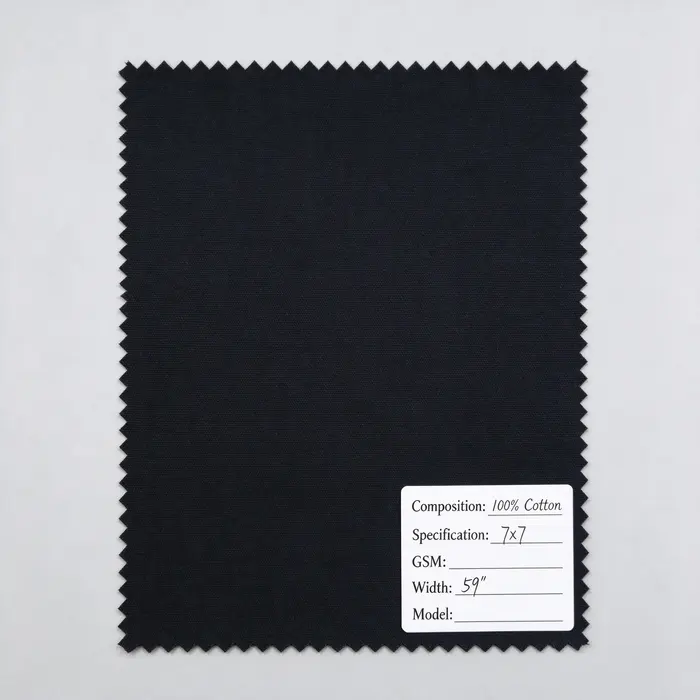
Sampling that proves performance. A professional anti-static canvas supplier should offer free A4-sized fabric swatches with the following documentation package: - Surface resistivity test report (EN 1149-1) - Charge decay test report (EN 1149-3) - GSM and construction sheet (ISO 3801) - Conductive yarn specification and grid/spacing diagram - Available functional coating options with compatibility confirmation
Conclusion
Anti-static canvas fabric has moved from a specialized niche to a mainstream industrial procurement category. The convergence of electronics miniaturization, explosive-atmosphere safety regulation, and cleanroom expansion across pharmaceutical and semiconductor manufacturing means that surface resistivity is now as critical a specification as tensile strength or coating weight.
For B2B buyers, the sourcing decision comes down to one question: are you buying structural ESD performance woven into the fabric — or a chemical spray that washes away when you need it most?
Related Products & Guides
Contact our team today to request free A4 samples with full EN 1149-1 test documentation, discuss custom conductive grid configurations for your specific application, or receive a bulk quotation for your anti-static canvas fabric requirements. Whether you need carbon-grid dissipative canvas for cleanroom curtains, conductive-stripe fabric for ESD equipment covers, or anti-static + FR composite materials for ATEX-rated environments — we manufacture to your specification, not ours.